
Seedream 5.0 Lite vs Nano Banana 2: which is better? 20 prompts tested
Published 2026-08-23 · Data measured 2026-08-23 · Updated 2026-09-05
We run a multi-model generation service, so we pay the invoice for every image our users make. Seedream 5.0 Lite and Nano Banana 2 sit next to each other in our image catalog, today at 9 credits for a 2048px Seedream image and 3 credits for a 1024px Nano Banana 2 image, which raises the obvious question: which one should the default be? We put identical prompts through both, on the exact routes we ship to users, and published every result below without cherry-picking. One run per prompt, 20 images in total, generated on 2026-08-23.
Price update, 2026-09-05. When this test ran on 2026-08-23 both models cost 9 credits and Nano Banana 2 only shipped at 1K. Since then Nano Banana 2 has dropped to 3 credits at 1K and gained 2K and 4K tiers at 5 and 8 credits; Seedream 5.0 Lite is unchanged at 9 credits for 2K. Every image, score and timing below is still from the 08-23 run, and we have not measured Nano Banana 2 at 2K or 4K.
TL;DR
- Four times the pixels for three times the credits. On our default settings Seedream 5.0 Lite returns 2048×2048 for 9 credits; Nano Banana 2 returns 1024×1024 for 3. Nano Banana 2 also lists a 2K tier at 5 credits, which undercuts Seedream on price, but we did not test it.
- Literal prompt following goes to Seedream. It placed exactly three sunflower pots where we asked for three, and filled the canvas with a flat poster when we asked for a flat poster. Nano Banana 2 drew six pots and put the poster inside a mock-up frame.
- Photographic realism goes to Nano Banana 2. Its portrait, product shot and street photo read as photographs. Seedream's portrait over-paints the freckles and its earbuds look like a render.
- Both failed the counting test. "Exactly five green apples" produced seven (Seedream) and six (Nano Banana 2). Do not trust either model with an exact count above four.
- Editing splits. Nano Banana 2 preserves composition pixel for pixel; Seedream preserves facial detail but re-renders the scene.
- Neither is fast. Both landed in the 35 to 110 second range through our queue. Nano Banana 2 was more consistent.
The setup
| Seedream 5.0 Lite | Nano Banana 2 | |
|---|---|---|
| Price on Vidney | 9 credits | 3 credits at 1K (5 at 2K, 8 at 4K) |
| Output at default settings | 2048×2048 | 1024×1024 |
| Aspect ratio sent | 1:1 | 1:1 |
| Time to image, 10 runs | 25s to 112s, median 61s | 35s to 76s, median 60s |
| Success rate | 10 of 10 | 10 of 10 |
Timing includes queue wait and our 8-second polling interval, so treat it as "what a user sees", not raw model latency. Nano Banana 2 now ships in 1K, 2K and 4K tiers on Vidney, priced per tier as listed in the table above, with the current credit prices on the model page and in the workbench; this test ran at the 1K default without measuring the others. Seedream 5.0 Lite returns 2K by default on this route with no extra parameter.
Round by round
Every prompt is printed in full so you can reproduce the run. Left is always Seedream 5.0 Lite, right is always Nano Banana 2.
1. Portrait: who looks like a photograph
Close-up portrait of a woman in her 40s with freckles and silver hoop earrings, soft window light from the left, shallow depth of field, 85mm lens, natural skin texture, no retouching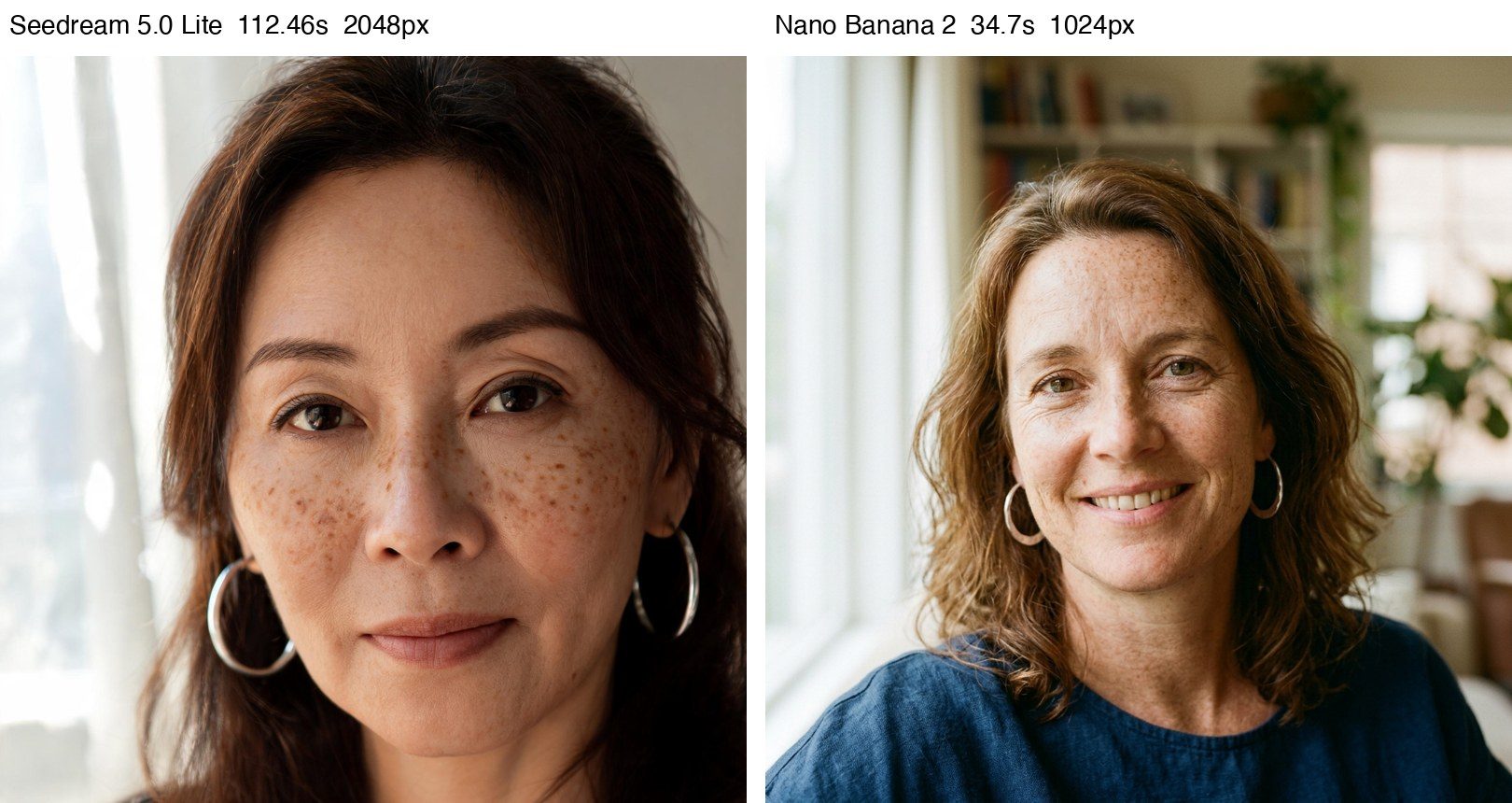
Seedream followed "close-up" literally and Nano Banana 2 did not. Nano Banana 2 won the realism anyway: skin, eyes and the bookshelf bokeh all look like a 35mm frame. Seedream's skin texture is good at 2K, but the freckle pattern is uniform in a way real freckles never are.
2. Text rendering: both spell correctly
A vintage travel poster for Kyoto with the exact headline "KYOTO IN AUTUMN" at the top and the words "Maple Season 2026" at the bottom, flat illustration, red and gold palette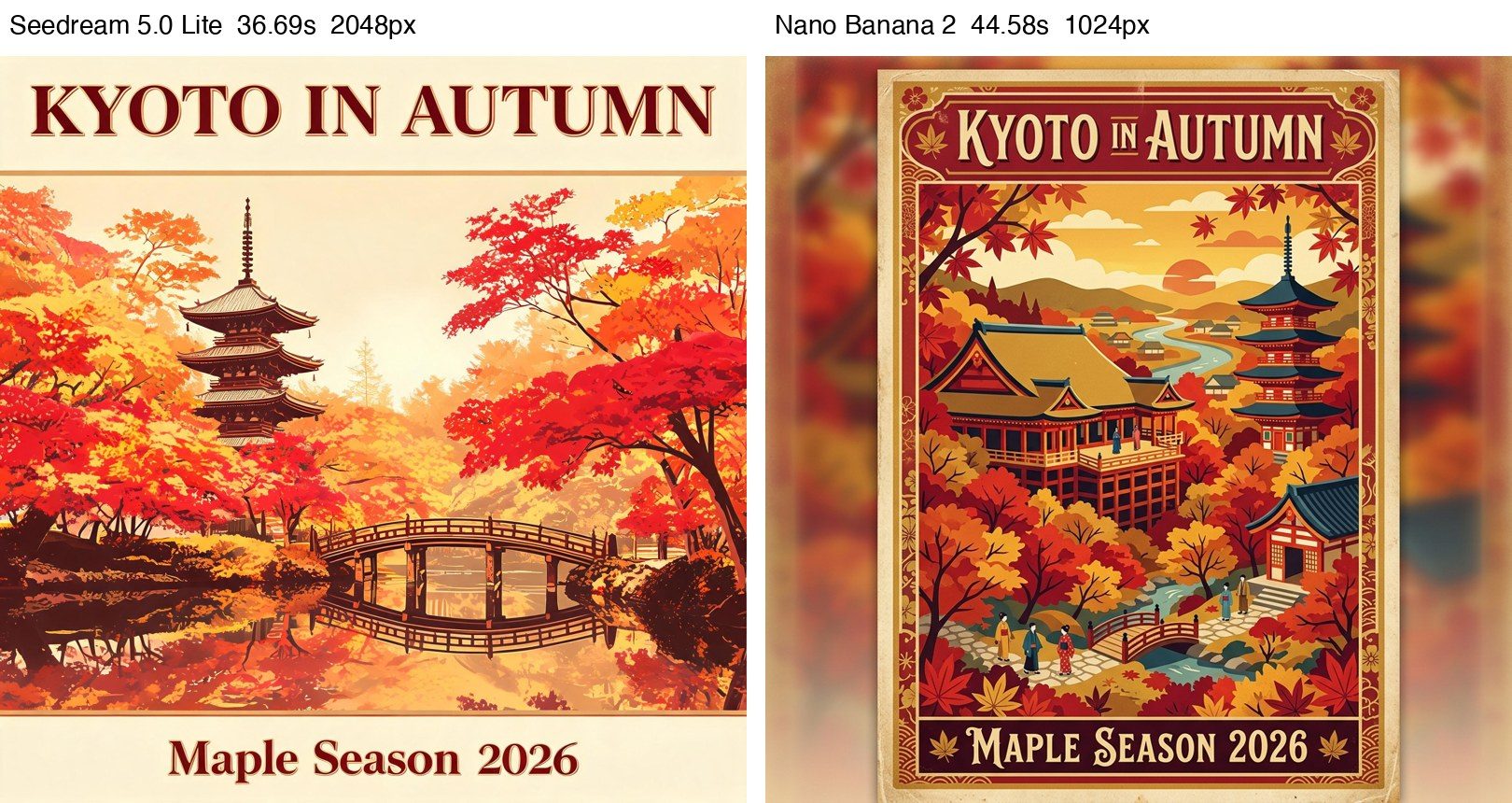
Text rendering used to be the test that separated image models. Not any more: both got every letter. The difference is composition. "Flat illustration" means a flat poster to Seedream and a photograph of a poster to Nano Banana 2. If you are making an actual poster, Seedream's output is usable as is; Nano Banana 2's needs a crop and then you are down to roughly 700px of poster.
3. Product shot: realism vs a clean white background
Studio product photo of a matte black wireless earbuds case, lid open, on a white seamless background, soft gradient shadow, subtle reflections on the glossy inner lid, e-commerce style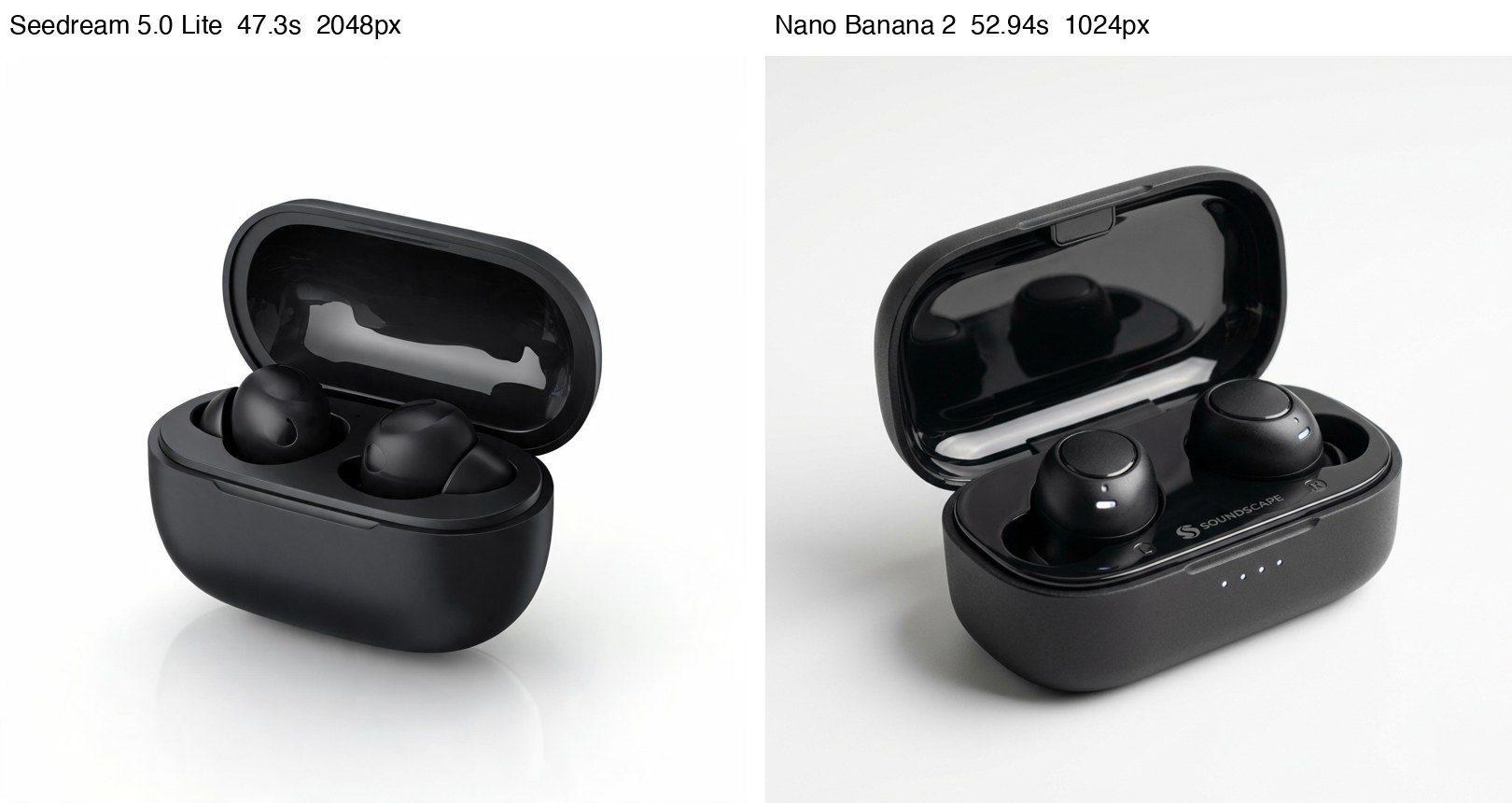
Seedream obeyed "white seamless background". Nano Banana 2 produced the image a buyer would trust, including small invented details (a logo, four charge LEDs) that make the object plausible. For a marketplace listing you would still have to remove the logo. For a concept render, Nano Banana 2 is closer to done.
4. Spatial layout: "three pots on the right"
A red bicycle leaning against a blue wooden door, a ginger cat sitting on the doorstep to the left of the bicycle, three potted sunflowers on the right side, morning light, photorealistic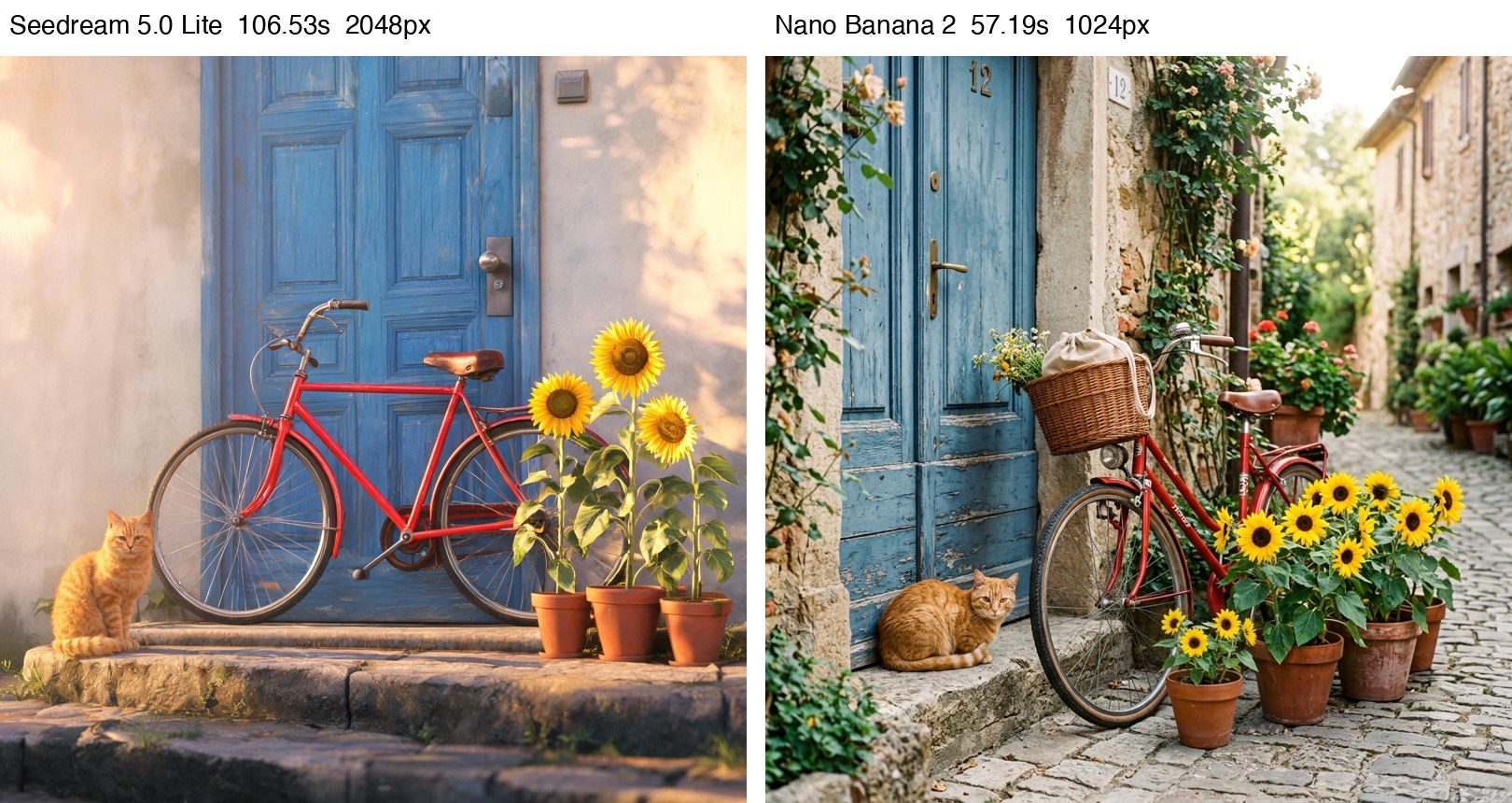
This is the clearest prompt-following result in the set. Seedream got every constraint, including the count. Nano Banana 2 got the scene and the mood, then multiplied the sunflowers. It is also the more beautiful image, with a cobblestone street receding into the distance, but "more beautiful than asked" is not a virtue when a client specified three.
5. Illustration: two valid readings of "whimsical"
Children's book illustration of a fox reading a book under a large mushroom in the rain, watercolor texture, soft pastel palette, whimsical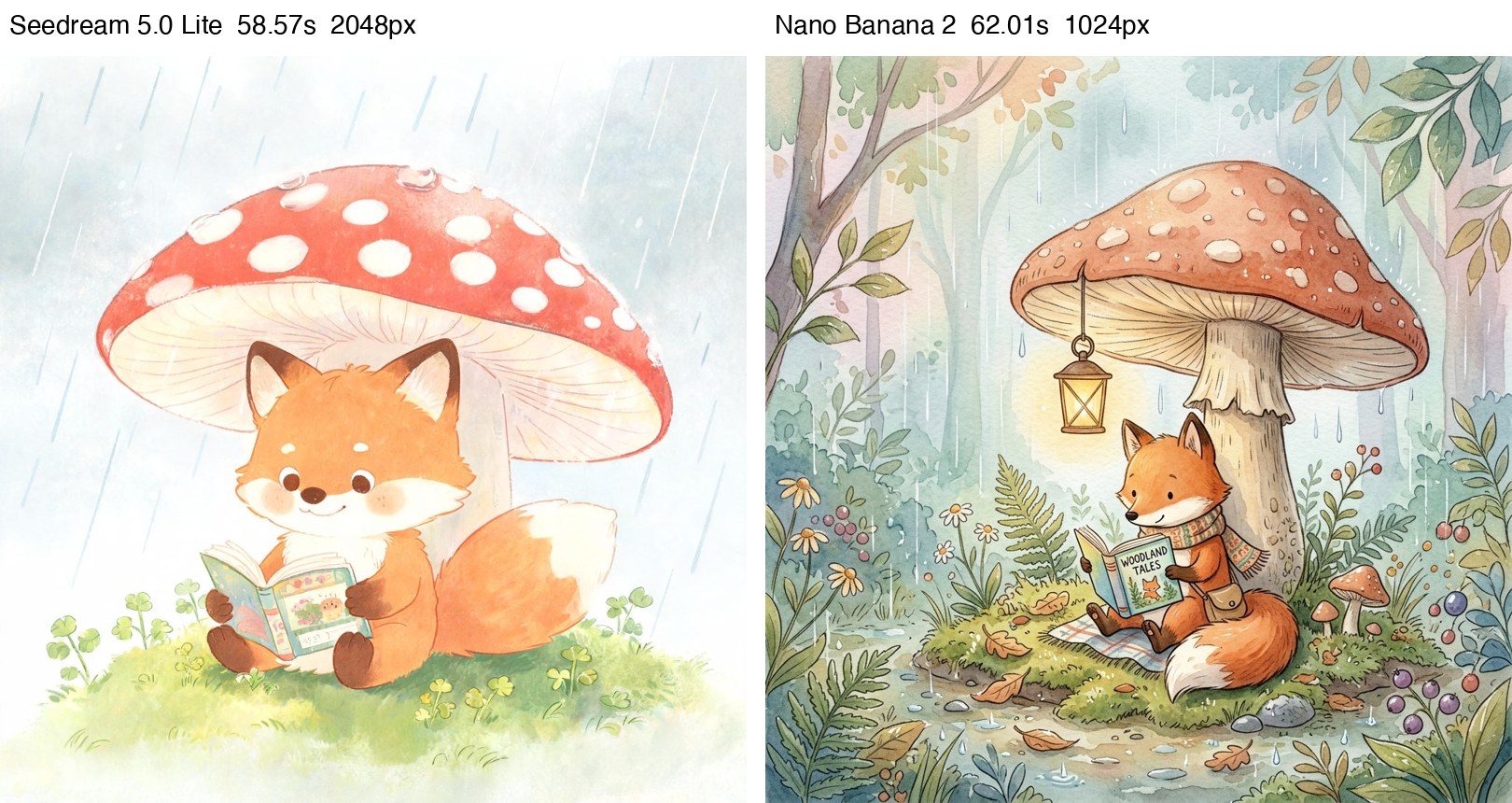
No winner here, just a taste difference. Seedream's version is closer to "soft pastel palette" and leaves room for text, which a picture-book page needs. Nano Banana 2's version has more story per square inch. Both are clean, with no broken paws or melted lettering.
6. Counting: both models fail
Exactly five green apples and two yellow pears arranged on a wooden table, overhead shot, one apple has a bite taken out, a folded linen napkin in the corner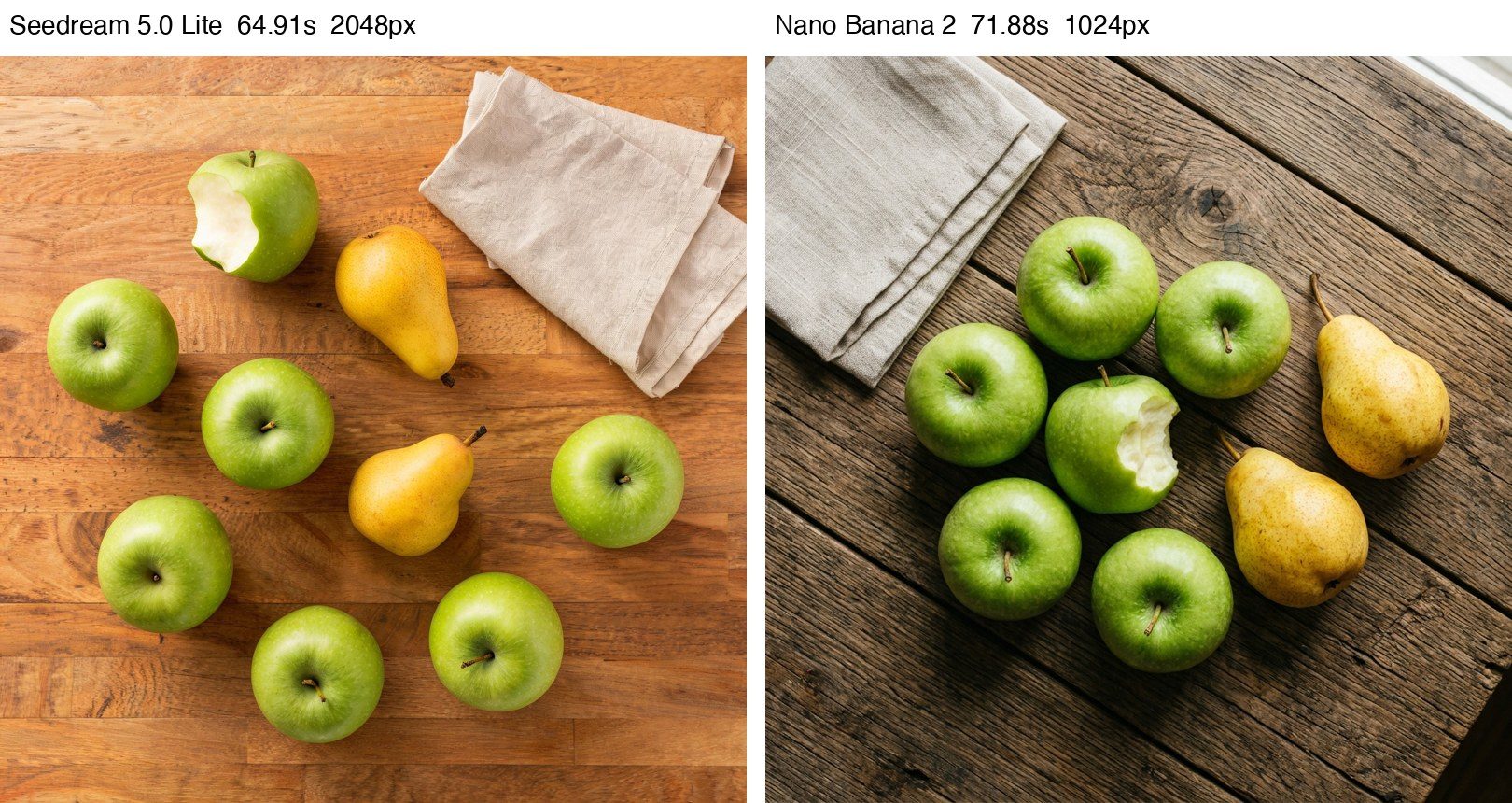
We asked for five. Neither model delivered. Everything else in the prompt landed: overhead angle, two pears, a single bitten apple, linen napkin in a corner. The lesson is the same as with every image model we have measured: exact counts above about four are a coin flip, and you should plan to generate several candidates or composite.
7. Cinematic: two kinds of drama
Cinematic wide shot of a lone lighthouse on a cliff during a thunderstorm at night, lightning illuminating the waves, anamorphic lens flare, film grain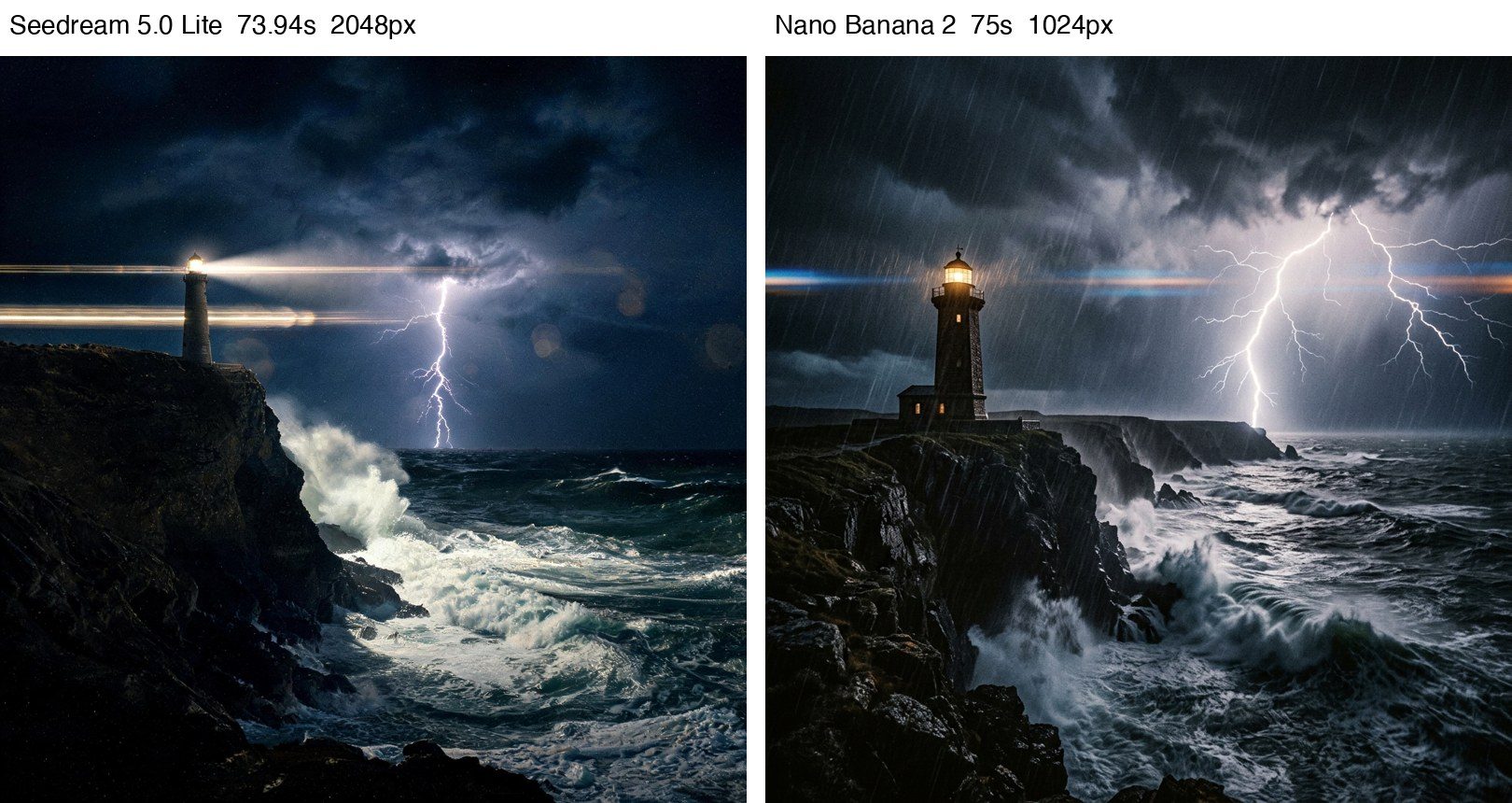
Both are frame-worthy. Seedream's reads like a film still; Nano Banana 2's reads like a high-end stock photograph. If "anamorphic lens flare" is the part of the prompt you care about, Seedream took it more seriously.
8. Street editorial: who is the subject
Fashion editorial photo of a man in an oversized beige trench coat crossing a zebra crossing in Tokyo at dusk, neon signs reflected in wet asphalt, slight motion blur on a passing taxi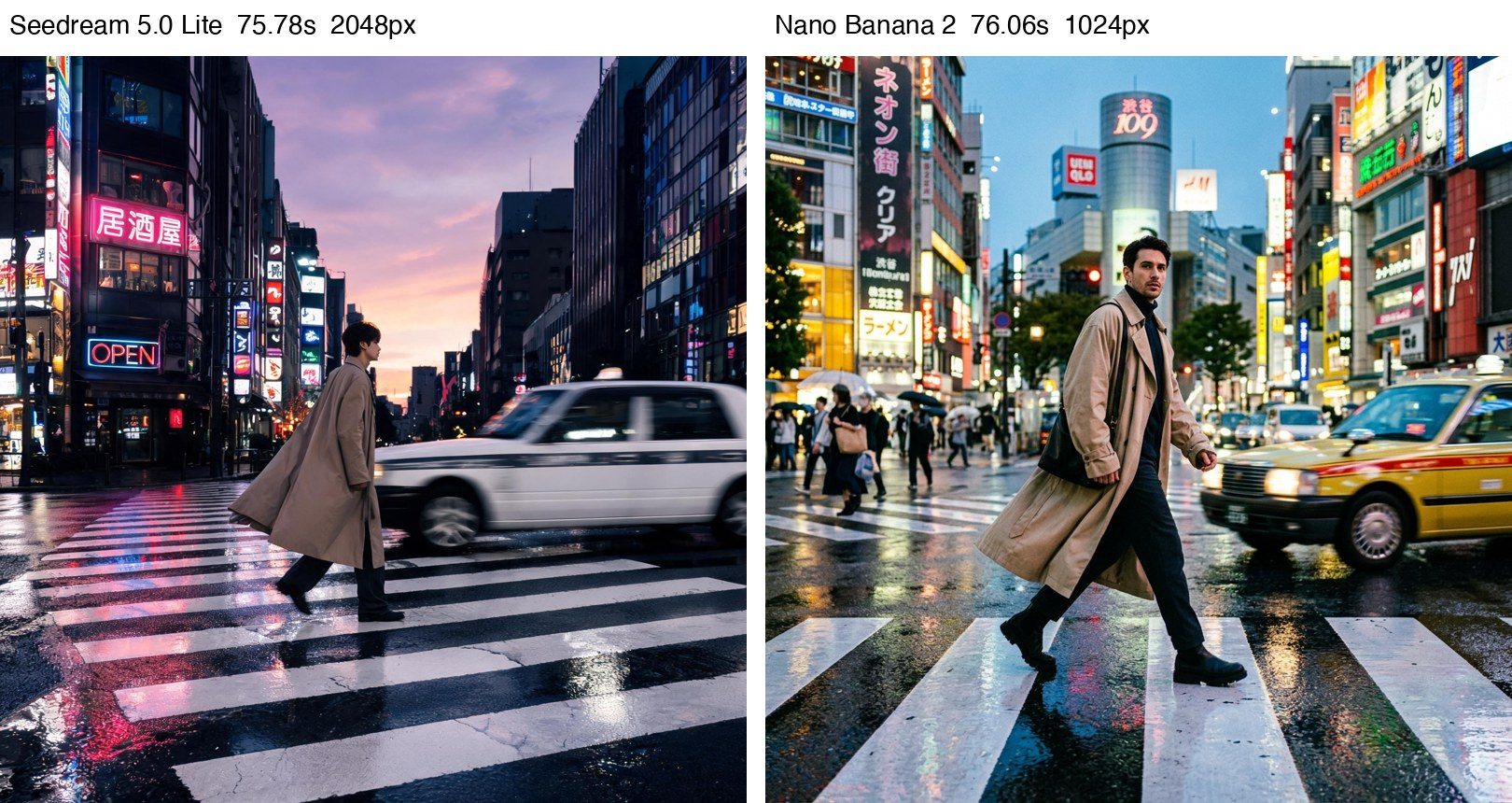
"Fashion editorial" implies the person is the subject, and Nano Banana 2 understood that. Seedream made a street photograph that happens to contain a man in a coat. Both nailed the wet-asphalt reflections and the taxi blur. Nano Banana 2's signage is so specific that it borders on real storefronts, which is something to watch if you publish the image commercially.
9. Editing a portrait: keep the face
Reference: Seedream's portrait from round 1, sent to both models.
Add round tortoiseshell glasses and a mustard yellow knit scarf. Keep her face, expression, hair, lighting and framing exactly the same.This one edits a reference image. Upload yours on the tool page first.
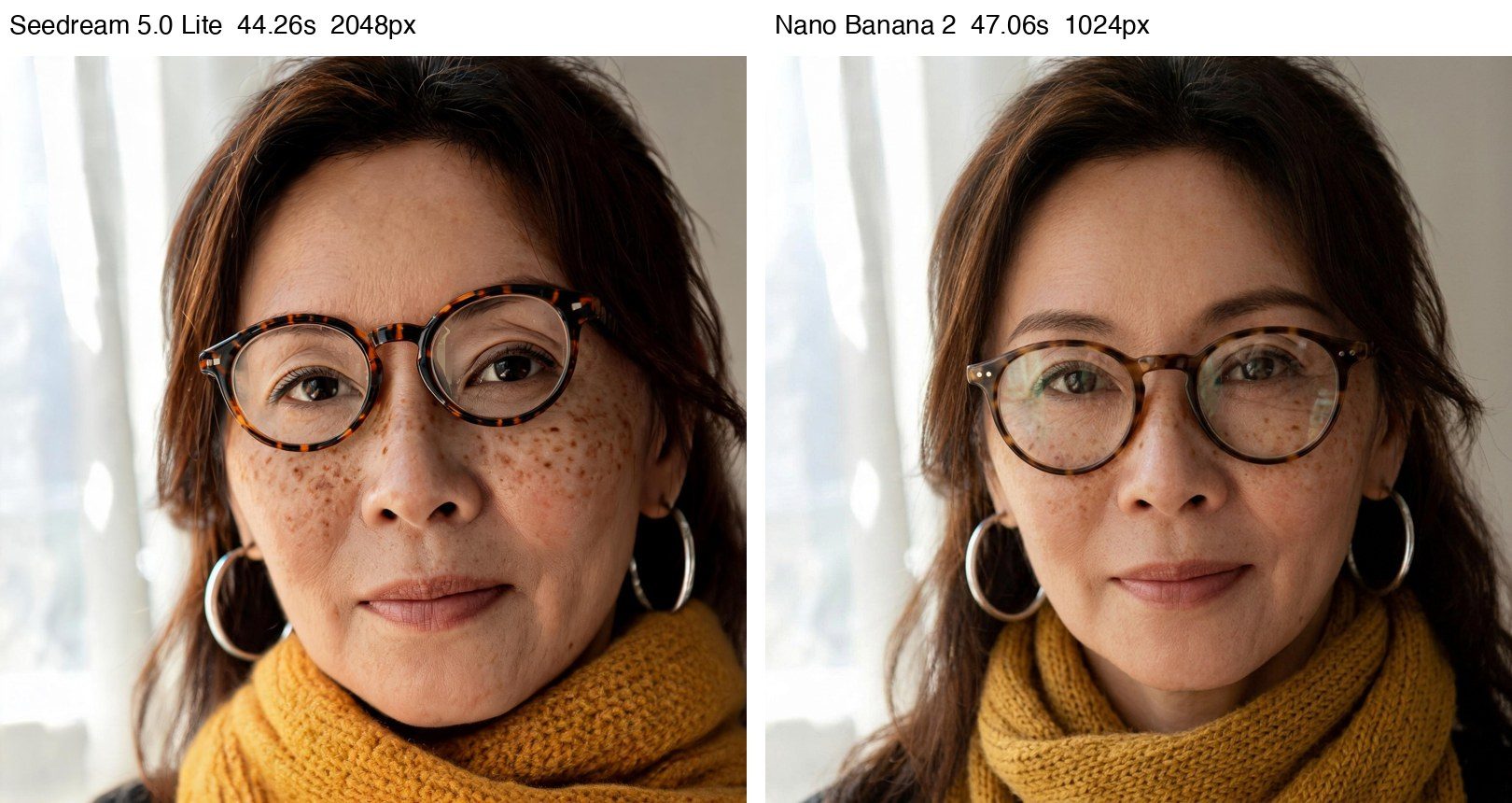
Both edits are successful in the sense that the woman is recognizably the same person wearing what we asked for. Seedream is more faithful to the source's skin detail. Nano Banana 2 applied a light beauty filter nobody requested.
10. Editing a product: keep everything else
Reference: Nano Banana 2's earbuds case from round 3, sent to both models.
Change the earbuds case color to matte olive green. Keep everything else identical, including the shadow and reflections.This one edits a reference image. Upload yours on the tool page first.
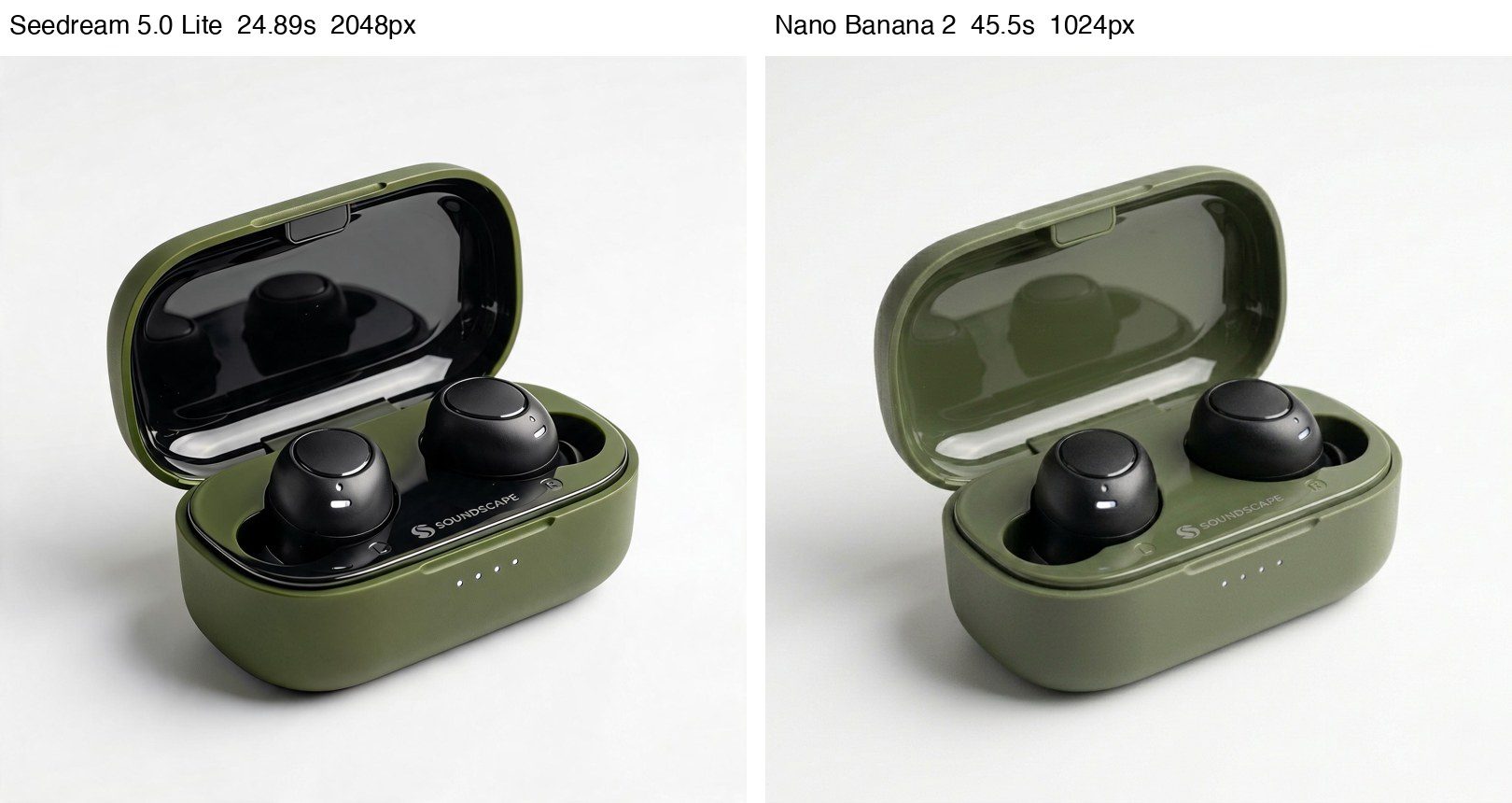
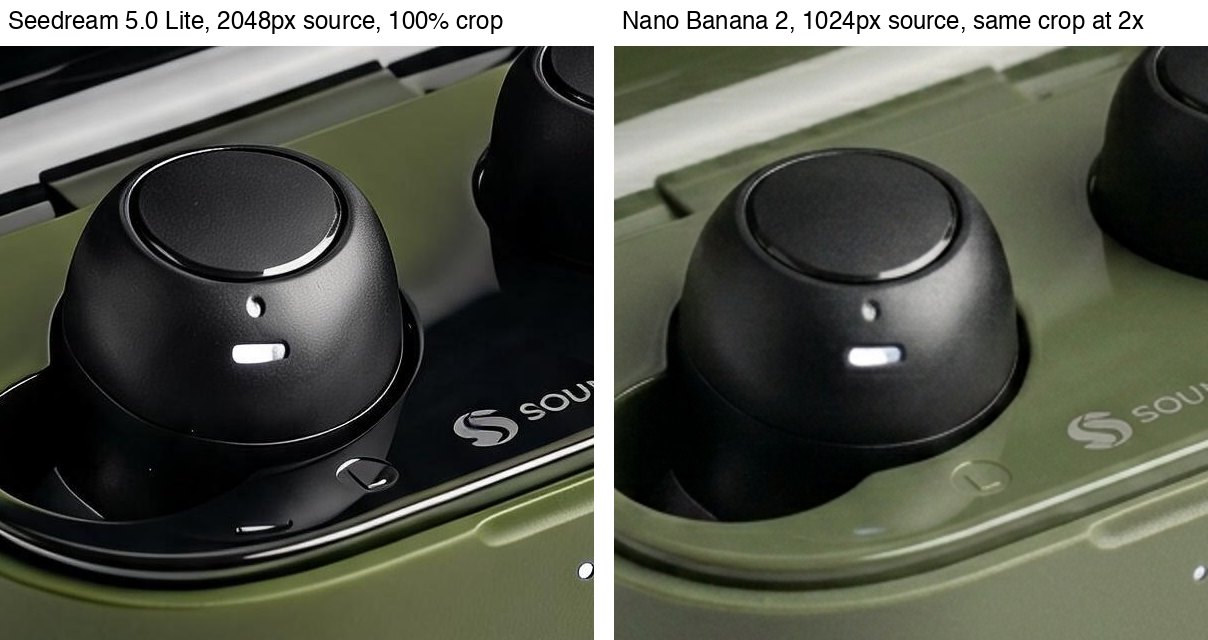
This is where Nano Banana 2's editing reputation shows. Put the two frames in a flip-book and the Nano Banana 2 pair is a perfect color swap. Seedream produced a new product shot of the same object, at 2K, which is impressive on its own but is not what "keep everything else identical" means.
Scorecard
| Round | What it tests | Seedream 5.0 Lite | Nano Banana 2 |
|---|---|---|---|
| 1 Portrait | realism, framing | follows "close-up" | looks like a photo |
| 2 Text | spelling, layout | correct, fills canvas | correct, poster-in-a-frame |
| 3 Product | white background, material | white background, weak object | grey background, convincing object |
| 4 Spatial | left/right, count of three | all constraints met | six pots instead of three |
| 5 Illustration | style | sparse pastel | dense and detailed |
| 6 Counting | exactly five | seven | six |
| 7 Cinematic | flare, grain | film still | HDR photo |
| 8 Street | subject emphasis | wide street scene | editorial subject |
| 9 Edit portrait | identity, detail | keeps skin detail | smooths skin |
| 10 Edit product | composition fidelity | re-renders scene | pixel-faithful swap |
| Resolution | default output | 2048×2048 | 1024×1024 |
Tally it however you like; our reading is a tie on points with opposite strengths, which is the most useful kind of result for a routing decision.
Which one should you pick
Pick Seedream 5.0 Lite when the prompt is a specification. Posters with text, layouts with counted objects, anything where a client wrote down constraints. It follows literal instructions more often, and the 2K file it returns for 9 credits is the only 2K output we have actually measured, which matters the moment the image goes to print or gets cropped.
Pick Nano Banana 2 when the prompt is a photograph. Portraits, product shots for a deck, street and lifestyle imagery. It produces the more believable photo in three of three realism rounds, and it is the model to use for color swaps and small edits where the rest of the frame must not move. At 3 credits per 1K image it is also the cheaper of the two by a wide margin.
Do not rely on either for exact counts. Generate three candidates and pick, or ask for a smaller number and add objects in a second edit pass.
Since this test ran, Nano Banana 2 has dropped to 3 credits at 1K and gained 2K and 4K tiers, while Seedream 5.0 Lite stays at 9 credits for 2K. The quality verdicts above are unchanged; on price alone Nano Banana 2 is now the cheaper model, and Seedream's case rests on the rounds it won, not on the invoice. Both run from the same AI image generator workbench, and the edit rounds above were done in image to image mode with the reference attached.
Method and limits
- One run per prompt, no re-rolls. A second seed could flip any single round; it is unlikely to flip the pattern.
- Default parameters only: 1:1 aspect ratio, no resolution override, no negative prompt, no seed. We tested what a user gets when they type a prompt and press generate.
- Both models were called through the routes we serve in production, not through each vendor's playground. Route and provider model IDs are in the setup table.
- Timing is end to end from our submit to our download, including provider queue and our polling granularity.
- Every image is published unedited apart from resizing for the side-by-side layout. Originals are 2048×2048 (Seedream) and 1024×1024 (Nano Banana 2).
All 2 models in this article, on Vidney
Run the same prompt on all 2 models from this article
Same workbench. Switch the model, rerun the prompt, compare side by side.
Nano Banana 2
$0.044per image
35% cheaper than the official Google API
Official Google API $0.067
Prices at the Creator annual rate. Official price is the API list price published by Google, checked September 5, 2026.