
Meilleur générateur vidéo anime IA en 2026 : Seedance 2.5, MiniMax H3, Kling 3.0 et Veo 3.1 à l'épreuve
Publié 2026-08-20 · Données mesurées 2026-08-20
La plupart des comparatifs de vidéo anime générée par IA montrent un clip trié sur le volet et une impression générale. Celui-ci est construit comme un directeur d'animation vérifie ses plans : cinq disciplines qui comptent vraiment en production d'anime, la même image de référence et le même prompt pour chaque modèle, des planches de frames denses plutôt que des ressentis, et la facture de chaque rendu. Nous avons généré 38 clips les 2026-08-19 et 2026-08-20 et noté 20 d'entre eux en confrontation directe. Chaque clip de cet article est la sortie brute, sans retouche.
TL;DR
| Discipline | Seedance 2.5 | MiniMax H3 | Kling 3.0 | Veo 3.1 |
|---|---|---|---|---|
| Mécanique du corps (dégainé iaijutsu) | 4.5 | 3 | 3 | 3 |
| Beauté plastique (contre-jour sur le toit) | 4.5 | 5 | 3.5 | 3 |
| Tenue du style (cel shading plat) | 5 | 4.5 | 4 | 4.5 |
| Jeu facial (sourire forcé qui s'effondre) | 5 | 4 | 3.5 | 2.5 |
| Narration (un beat d'histoire en 10 secondes) | 3.5 | 4.5 | 4 | 4 |
| Total (sur 25) | 22.5 | 21 | 18 | 17 |
- Seedance 2.5 gagne à la discipline : micro-expressions et stabilité du style jouent une classe au-dessus, et il n'est jamais sorti de son personnage. C'est aussi le rendu le plus cher du test : $5.423 par clip de 10s en 720p.
- MiniMax H3 gagne sur l'animation de processus et l'atmosphère : c'est le seul modèle qui dépense des frames sur les actions intermédiaires (un parapluie qui s'ouvre, un accroupissement), et le seul dont les clips arrivent avec un son natif. Son activé, son clip du toit est le plan le plus touchant du test. Sa faiblesse, c'est la logique physique : il a rengainé un katana à l'envers.
- Kling 3.0 est le choix budget : $1.68 par rendu, 31% du prix de Seedance, ne s'effondre jamais, ne surprend jamais non plus.
- Veo 3.1 a le plafond le plus haut et la pire discipline : il a bouclé des chaînes d'action que personne d'autre n'a finies, puis il a réécrit notre direction émotionnelle, sauté d'angle de caméra et dérivé vers le photoréalisme. Il plafonne aussi à 8 secondes.
- Zéro clip rejeté par les filtres de contenu. Zéro visage tombé dans la vallée de l'étrange en 38 rendus. L'anime est un genre sûr pour ces modèles, d'une façon que les humains photoréalistes ne sont pas.
Comment nous avons testé
Chaque discipline reçoit une scène. Chaque scène a une image de référence (générée une fois, réutilisée pour les quatre modèles) et un prompt écrit comme une indication de storyboard : un seul mouvement continu, un langage caméra explicite, un « pas de morphing, pas de coupes » explicite. Tous les modèles ont tourné en 10 secondes, classe 720p, 16:9, par les mêmes routes que nous utilisons en production chez Vidney.
La notation va de 1 à 5 par discipline. Chaque clip passe par six filtres professionnels :
- Plausibilité physique : maniement des accessoires, mécanique du corps, gravité, comportement des fluides. Un beau clip qui rengaine un sabre à l'envers échoue ici.
- Esthétique : composition, lumière, couleur.
- Fluidité du mouvement : des intervalles continus plutôt que des téléportations et des glissements.
- Travail de caméra : le plan tient-il la direction donnée, et le mouvement est-il motivé.
- Qualité de rendu : stabilité du trait, intégrité des détails, artefacts.
- Respect de la direction : le clip demandé, pas un autre bon clip.
MiniMax H3 livre un son natif avec chaque clip ; le son est noté là où il change la façon dont le plan atterrit, et signalé explicitement quand c'est le cas. Les verdicts partent de planches de frames denses (planches contact à 2fps), et tout verdict qui dépend d'un beat rapide ou d'une interaction physique est rééchantillonné à 6 à 10fps et revu à vitesse réelle.
Trois divulgations, parce qu'elles changent la lecture du tableau :
- Veo 3.1 n'a pas d'option 10 secondes. Ses durées possibles sont 4, 6 et 8 secondes. Ses clips ici font 8s, il travaille donc avec 20% de temps d'écran en moins que les autres.
- La résolution livrée par Kling 3.0 dérive. Nous avons demandé du 720p et reçu 1284x716, 1304x704 et 1316x700 selon les rendus, vérifié avec ffprobe. Chaque chiffre de résolution de cet article vient du fichier de sortie, pas de la requête.
- Les planches contact à 2fps ont un angle mort d'échantillonnage sur les actions rapides. Là où un verdict dépendait d'un beat rapide, nous avons rééchantillonné à 10fps avant de noter. Un score a changé pour cette raison, documenté dans la discipline 1.
Ce que chaque rendu a coûté
Les montants sont les coûts par rendu débités sur nos routes de production, relevés le 2026-08-20. La route H3 est celle que nous avions déjà mesurée à $1.9 par rendu de 10 secondes en 768p ; son montant par rendu a été identique sur les 14 rendus de ce test.
| Modèle | Coût par rendu | Temps réel moyen | Résolution livrée (ffprobe) |
|---|---|---|---|
| Seedance 2.5 | $5.423 | 251s | 1280x720, 10.05 à 10.08s |
| MiniMax H3 | équivalent de $1.9 | 465s | 1344x768, 10.12s |
| Kling 3.0 | $1.68 | 122s | 1284x716 à 1316x700 |
| Veo 3.1 | $3.2 | 85s | 1280x720, 8.00s |
Deux notes opérationnelles qui intéresseront la production : le prix par rendu s'est montré totalement insensible à la complexité du prompt (14 débits identiques par modèle sur des scènes très différentes), on peut donc budgéter linéairement. Et le temps réel n'est pas corrélé à la qualité ici : Veo est le plus rapide et le moins cher par seconde du segment premium, Kling est le plus rapide tout court.
Discipline 1 : mécanique du corps. Un dégainé iaijutsu en un seul arc
Le test : une sabreuse dégaine, coupe en un seul arc horizontal, tient la pose, puis rengaine. Caméra latérale fixe. Le transfert de poids doit se lire d'abord dans les hanches, puis les épaules, puis la lame, et le sabre doit rester rigide.
Cette discipline a produit le seul score corrigé pendant la relecture. Sur la planche à 2fps, la coupe de Seedance ressemblait à une téléportation entre « main sur la poignée » et « lame tendue », nous avons donc rééchantillonné les 2.5 premières secondes à 10fps :
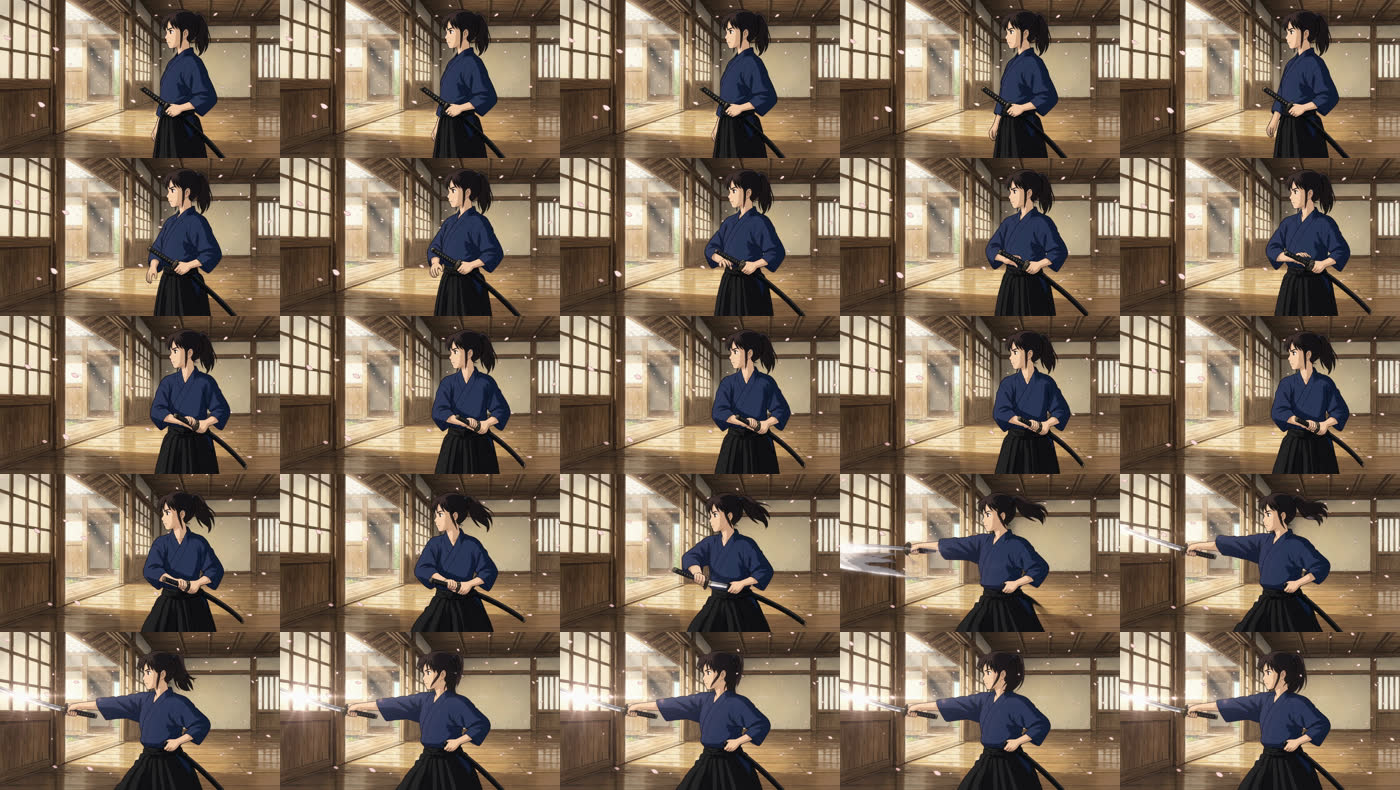
La déduction restante sur Seedance est honnête : vers la marque des 5.5s, la lame plie pendant un frame au retour.
L'échec de H3, c'est le filtre de plausibilité physique qui fait son travail. À 6fps, le rengainage se lit clairement : la lame pivote par une orientation qui ne peut pas entrer dans le fourreau, puis arrive quand même logée. Chaque frame isolée semble correcte ; la séquence est impossible. Peut-on contourner par le prompt ? Partiellement : détailler la mécanique (« guider le dos de la lame le long de l'ouverture du fourreau, pointe d'abord ») améliore les chances, mais la logique de manipulation d'objets est une capacité du modèle, pas un problème de formulation, et les rustines de prompt sur la physique ont un plafond. L'échec de Kling est différent et tout aussi instructif : il n'a pas raté l'animation, il a raté le vocabulaire martial, en convertissant un dégainé-coupé horizontal en frappe verticale générique. Si votre storyboard dépend d'une grammaire de mouvement précise, seul Seedance l'a tenue de bout en bout dans ce test.
Discipline 2 : beauté plastique. Heure dorée sur un toit, cheveux en contre-jour
Le test : du vent, un contre-jour qui flambe à travers les mèches, des pétales, une rotation lente vers la caméra. C'est le plan que tout générique d'anime possède, et il vit ou meurt sur la physique des cheveux et la discipline de la lumière.
C'est dans cette discipline que le son cesse d'être une note de bas de page. En muet, la discipline de Seedance gagne aux points. Avec le son, la version de H3 atterrit comme un plan fini : le lit de vent et la montée musicale sous la rotation font plus pour l'atmosphère que n'importe quel choix visuel isolé dans le cadre. La beauté en image animée est audiovisuelle, donc H3 prend la discipline. Le motif de fond tient toujours : H3 échange la continuité contre l'impact, Seedance respecte le contrat, Veo le réécrit.
Discipline 3 : tenue du style. Dix secondes de cel shading plat, sans dérive
Le test : un rendu volontairement plat, gros contours, ombrage deux tons, doit survivre à dix secondes de marche dans une lumière de torches vacillante. La dérive du style vers le photoréalisme ou vers un ombrage pictural doux est la plainte numéro un des artistes en activité face à la vidéo IA, nous en avons donc fait une discipline.
La découverte qui nous a surpris : les quatre modèles ont tenu un style fort quand l'image de référence le portait. Veo a dérivé vers le photoréalisme sur la scène du toit mais est resté plat ici, parce que cette image de référence est agressivement stylisée. Si la stabilité du style compte, investissez dans l'image de référence ; elle ancre plus fort que n'importe quel texte de prompt.
Discipline 4 : jeu facial. Un sourire forcé qui s'effondre en larmes
Le test : gros plan statique, un seul arc continu de micro-expressions : sourire tenu, lèvre qui tremble, larmes qui montent, une larme qui déborde, lèvres pincées, visage qui se détourne. Pas de coupes, pas de morphing. C'est la chose la plus difficile de l'animation et le chemin le plus court vers la vallée de l'étrange.
Zéro moment de vallée de l'étrange sur les quatre, dans la discipline conçue pour en produire. Les visages stylisés sont simplement un support plus sûr pour l'émotion synthétique que les visages photoréalistes, et pour les workflows anime, cela retire le mode de défaillance le plus effrayant de la vidéo IA.
Discipline 5 : narration. Un beat d'histoire complet en dix secondes
Le test : nuit pluvieuse, un employé de supérette remarque une fille en imperméable jaune qui abrite un chaton, hésite, s'avance sous la pluie, tient son parapluie au-dessus d'elle, les regards se croisent. Quatre temps, deux personnages, dont un inventé par le modèle à partir du seul prompt.
La narration inverse le classement, et c'est aussi là que le filtre de plausibilité physique coupe deux fois. H3 gagne la discipline parce que son animation de processus survit à la revue physique : le parapluie s'ouvre frame par frame et voyage là où voyage un parapluie. Seedance et Veo bouclent tous deux l'histoire et ratent tous deux un contrôle physique en chemin : Seedance téléporte le garçon sous un parapluie ouvert trop bas, Veo le fait glisser sur l'asphalte mouillé au lieu de le faire marcher. Si nous devions monter un trailer, le clip de H3 est celui que nous livrerions tel quel.
Quel modèle un créateur d'anime devrait vraiment choisir
Prenez Seedance 2.5 quand le plan est dirigé. Storyboards verrouillés, jeu de personnage, séquences critiques pour le style. Il suit la direction comme un animateur senior et se paie comme tel : $5.423 la prise de 10 secondes, grosso modo trois Kling par clip.
Prenez MiniMax H3 quand le plan doit sembler animé et sonner vivant. Animation de processus, scènes à plusieurs temps, et un son natif synchronisé que personne d'autre n'a dans ce groupe : son activé, il a remporté notre discipline beauté haut la main (nous avons mesuré sa facturation audio et référence séparément). Revérifiez tout clip impliquant une manipulation d'objet précise, et budgétez la file la plus lente : 465 secondes de temps réel moyen.
Prenez Kling 3.0 quand le volume compte plus que le sommet. À $1.68, l'itération devient une non-décision : quatre prises pour le prix d'un Seedance, et on garde la bonne. Ne lui confiez simplement pas une chorégraphie qui dépend d'un vocabulaire de mouvement précis, et lisez sa résolution livrée dans le fichier, pas dans la requête.
Prenez Veo 3.1 quand vous voulez une opinion forte en huit secondes. Laissez-lui de la place pour interpréter et il rend le beat court le plus abouti du test. Ne lui donnez pas un storyboard verrouillé ; il renégociera.
Et une règle de workflow qui se généralise aux quatre : l'image de référence est le contrat de style. Chaque modèle a tenu une référence fortement stylisée pendant dix secondes ; la seule scène à la référence plus douce est celle où la dérive est apparue.
Pour un œil formé à la ligne claire et à l'école franco-belge de la bande dessinée, la discipline 3 est celle qui départage vraiment : un trait qui vibre ou s'épaissit d'un frame à l'autre se voit immédiatement, bien avant les questions de physique. Sur ce critère précis, la tenue du trait de Seedance et la retenue de Kling parlent davantage à cette tradition que les libertés somptueuses de Veo.
Et ensuite
Le même harnais à cinq disciplines, relancé avec des styles graphiques par marché : cel-action et lumière à la Shinkai pour le Japon, cadrage webtoon pour la Corée, wuxia au lavis d'encre et xianxia gongbi pour les lecteurs en chinois traditionnel. Ces 18 rendus sont déjà générés et notés ; les éditions localisées paraissent en même temps que celle-ci. Pour reproduire n'importe quel clip de cet article, les images de référence, les prompts et les paramètres sont exactement tels que décrits, et le workflow tourne de bout en bout dans Reference to Video.
Limites
- Un rendu par modèle et par scène. Cela mesure des prises uniques dirigées, pas des distributions statistiques de qualité. Les prix et les comportements peuvent changer ; chaque chiffre porte sa date de mesure.
- Les cinq images de référence ont été générées par un seul modèle d'image et partagées entre les quatre modèles vidéo, le biais du modèle d'image s'applique donc également à chaque ligne.
- Veo 3.1 a travaillé avec des prises de 8 secondes contre 10 pour les autres, une limite structurelle divulguée plus haut plutôt que normalisée.
- Les scores viennent d'un seul relecteur appliquant la grille à six filtres sur des planches de frames denses, avec rééchantillonnage à 6 à 10fps là où les verdicts dépendaient de beats rapides ou d'interactions physiques. Les planches et les 20 clips sont publiés, vous pouvez donc re-noter vous-mêmes.
- Note de révision (2026-08-20) : après publication, une seconde revue à vitesse réelle et son activé a changé trois scores. Le clip iaijutsu de H3 est passé de 3.5 à 3 (le rengainage est physiquement impossible à la revue 6fps), le clip du toit de H3 est passé de 4 à 5 (le son natif change matériellement le plan), les clips narratifs de Seedance et Veo sont passés de 4 et 4.5 à 3.5 et 4 (téléportation du parapluie ; marche glissée). La première passe sur planches seules sous-pondérait la physique et ne pouvait pas peser le son ; la grille ci-dessus est la version corrigée. Nous laissons cette note ici plutôt que d'éditer les chiffres en silence.
Les 4 modèles de cet article, sur Vidney
Tous les modèles de cet article, un seul atelier
Même atelier : changez de modèle, relancez le prompt, comparez côte à côte.